Uploading a Unity Webgl Build to Weebly
Edifice and distributing a WebGL project
Reduce load times with AssetBundles
Building your WebGL application
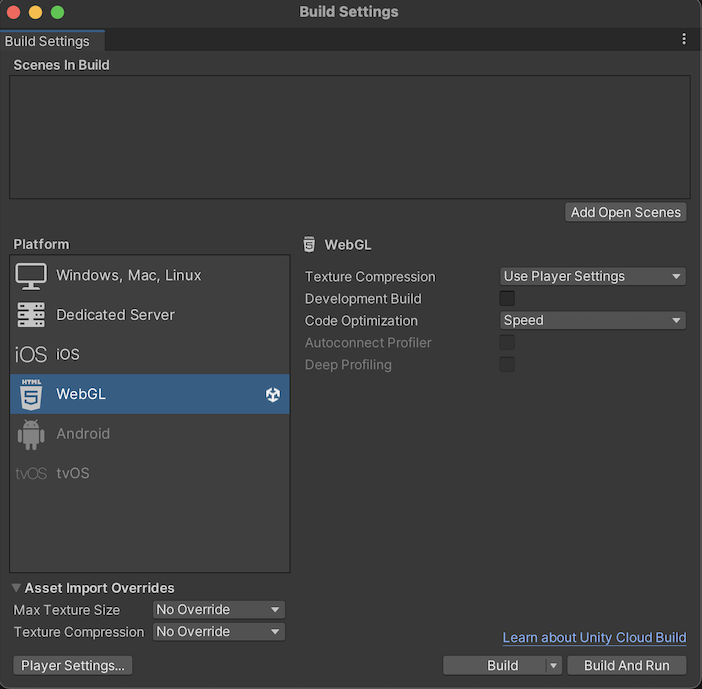
To create a build for WebGL, go to File > Build Settings from Unity'southward chief menu. In the Platform list, select WebGL and then click Switch Platform.
When yous have configured the Build Settings, choose from the following 2 options:
- Build builds your application into a Player.
- Build and Run builds your application in a Thespian, and opens that Player on your target platform.
The Unity build system for WebGL A JavaScript API that renders 2d and 3D graphics in a web browser. The Unity WebGL build option allows Unity to publish content as JavaScript programs which use HTML5 technologies and the WebGL rendering API to run Unity content in a web browser. More than info
Run into in Glossary supports the following settings:
| Setting | Function | |
|---|---|---|
| Texture Compression A method of storing data that reduces the amount of storage space it requires. See Texture Compression, Animation Pinch, Audio Compression, Build Compression. See in Glossary | Select from the available formatting options below to set the default texture pinch 3D Graphics hardware requires Textures to exist compressed in specialized formats which are optimized for fast Texture sampling. More info See in Glossary format for the textures in the project.You can also use this setting to alter from a script or using the control-line switch -setDefaultPlatformTextureFormat. For more data, run across the texture compression format overview.This setting is also available in the Player settingsSettings that let you fix various player-specific options for the last game built by Unity. More than infoSee in Glossary window. | |
| Use default format (DXT) | This is the default compression format. | |
| ETC | This extension is part of the WebGL API and exposes the ETC compressed texture format A file format for handling textures during real-time rendering past 3D graphics hardware, such equally a graphics carte du jour or mobile device. More than info See in Glossary . | |
| ETC2 | This extension is role of the WebGL API and exposes the ETC compressed texture format. Utilize this texture compression format if using OpenGL four.3. | |
| ASTC | This texture compression format is a popular choice due its wide range of derived compression ratios. For case, ASTC pinch is bachelor for about Intel GPUs and Nvidia Tegra chips. | |
| DXT | This extension supports the DXTn/BCn compression format. | |
| Development Build A development build includes debug symbols and enables the Profiler. More than info Run across in Glossary | Enable this setting to include scripting debug symbols and the Profiler in your build. When you enable this, Unity sets the DEVELOPMENT_BUILD scripting define. You lot should use this setting only when you lot want to test your application. Annotation that development builds do not minify content, which means the development builds are very large to distribute. | |
| Code Optimization | Select the optimization fashion to employ for compiling the WebGL code. | |
| Speed | This is the default setting. Selecting this generates WebGL lawmaking that is optimized for runtime performance. | |
| Size | Selecting this generates WebGL lawmaking that is optimized for build size. This is particularly useful when building WebGL games to run on mobile browsers on Android and iOS Apple's mobile operating organization. More info See in Glossary , where the default optimize-for-speed pick would generate larger WebAssembly files for mobile devices to swallow. | |
| Autoconnect Profiler | Typically, when enabled, this setting allows you to automatically connect the Unity Profiler to your build. However, for WebGL, as you cannot connect the ProfilerA window that helps you lot to optimize your game. It shows how much time is spent in the various areas of your game. For instance, it tin study the percentage of fourth dimension spent rendering, animative, or in your game logic. More info See in Glossary to a running build, use this option to connect the content to the Editor instead. This is because the Profiler connexion is handled using WebSockets on WebGL, merely a web browser simply allows outgoing connections from the content. For this setting to exist available, y'all should enable the Development Build option. | |
| Deep Profiling Support | Enable this setting to turn on Deep Profiling in the Profiler. This makes the Profiler instrument every function call in your application and returns more detailed profiling data. When yous enable Deep Profiling Support, it might irksome downwardly script execution. This option is merely available if you enable the Development Build selection. | |
| IL2CPP Code Generation | Define how Unity manages IL2CPP code generation. This option is only available if yous are using IL2CPP for your scripting backend, not Mono. To change your scripting backend, go to Histrion Settings > Configuration > Scripting Backend and alter from Mono to IL2CPP. | |
| Faster runtime | Generates lawmaking that is optimized for runtime performance. This is the default behavior in previous versions of Unity. | |
| Faster (smaller) builds | Generates code that is optimized for build size and iteration. Information technology generates less code and produces a smaller build, but may take an impact on runtime performance, especially for generic lawmaking. You might want to utilize this option when faster build times are important, such as when iterating on changes | |
| Build | Utilise it build your application. | |
| Build And Run | Use information technology to view the WebGL Histrion locally. Unity uses a local web server to host your build, and opens it from a localhost URL. Alternatively, you lot can utilise a custom local web server with properly configured response headers. For more information, see WebGL: Compressed builds and server configuration. | |
For changing the settings for Asset Import Overrides, meet Build Settings.
Build Folder
The Build folder contains the following files ([ExampleBuild] represents the name of the target build folder).
| File proper noun | Contains |
|---|---|
[ExampleBuild].loader.js | The JavaScript lawmaking that the web page needs in guild to load the Unity content. |
[ExampleBuild].framework.js | JavaScript runtime and plugins. |
[ExampleBuild].wasm | WebAssembly binary. |
[ExampleBuild].mem | A binary image to initialize the heap retention for your Histrion. Unity but generates this file for multi-threaded WebAssembly builds. |
[ExampleBuild].data | Asset data and Scenes A Scene contains the environments and menus of your game. Think of each unique Scene file as a unique level. In each Scene, you lot place your environments, obstacles, and decorations, essentially designing and building your game in pieces. More info See in Glossary . |
[ExampleBuild].symbols.json | Debug symbol names necessary to demangle an fault stack trace. This file is only generated for Release builds when you enable the Debug Symbols pick (File > Build Settings > Thespian Settings.) |
[ExampleBuild].jpg | A background epitome, which displays while the build is loading. This file is merely generated when a Groundwork Image is provided in the Player Settings (File > Build Settings > Player Settings > Splash Image). Come across the Splash Screen page for further data. |
If you enable a Compression Method for your build, Unity identifies the extension that corresponds with the compression method and adds this extension to the names of the files inside the Build subfolder. If you enable Decompression Fallback, Unity appends the extension .unityweb to the build file names. Otherwise, Unity appends the extension .gz for the Gzip compression method, or .br for the Brotli compression method. For more information, encounter WebGL: Compressed builds and server configuration.
If yous enable Name Files As Hashes in the Player Settings, Unity uses the hash of the file content instead of the default filename. This applies to each file in the build binder. This option allows yous to upload updated versions of the game builds into the same folder on the server, and only upload the files which have changed between build iterations.
Annotation: Opening a Player straight from the file system might not work in some browsers. This is due to security restrictions applied to local file URLs.
Deep Profiling Support
Enable the Deep Profiling Back up setting to make the Unity Profiler contour every function call in your application. For more information run across the documentation on Deep Profiling.
Player settings
WebGL has some additional options in the Role player settings (bill of fare: Edit > Project Settings A broad collection of settings which allow you to configure how Physics, Audio, Networking, Graphics, Input and many other areas of your project behave. More info
See in Glossary , then select the Histrion category).
Other Settings

Strip Engine Code
Open Other Settings to admission the Strip Engine Code option. This option is checked past default to enable lawmaking stripping for WebGL. With this option checked, Unity does not include code for any classes you don't use. For example, if y'all don't utilize any physics components or functions, the whole physics engine A organisation that simulates aspects of physical systems so that objects can accelerate correctly and be affected by collisions, gravity and other forces. More info
See in Glossary is removed from your build. See the Stripping section beneath for more details.
Publishing Settings
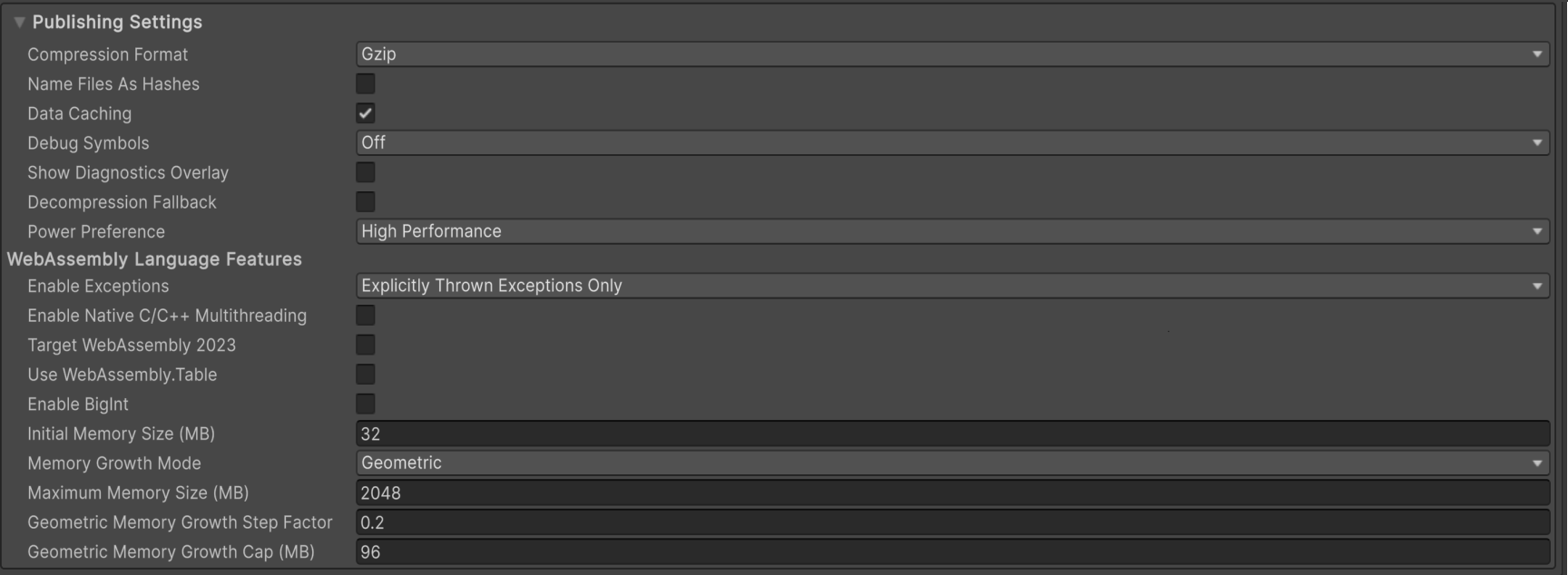
Enable Exceptions
Open Publishing Settings to access Enable Exceptions. Enable Exceptions allows you to specify how unexpected code behavior (generally considered errors) is handled at run time. It has these options:
- None: Select this if you don't need whatever exception support. This gives the best functioning and smallest builds. With this option, whatsoever exception thrown causes your content to stop with an error in that setting.
- Explicitly Thrown Exceptions Only (default): Select this to capture exceptions which are explicitly specified from a
throwstatement in your scripts A slice of code that allows you to create your own Components, trigger game events, modify Component backdrop over time and respond to user input in any style y'all like. More info
Encounter in Glossary and to also ensurefinallyblocks are chosen. Notation that selecting this option makes the generated JavaScript lawmaking from your scripts longer and slower; This might only be an consequence if scripts are the master bottleneck in your project. - Full Without Stacktrace: Select this option to capture:
- Exceptions which are explicitly specified from
throwstatements in your scripts (the same as in the Explicitly Thrown Exceptions Only option) - Null References
- Out of Bounds Array accesses
- Exceptions which are explicitly specified from
- Full With Stacktrace: This option is similar to the option in a higher place just it also captures Stack traces. Unity generates these exceptions by embedding checks for them in the lawmaking, then this option decreases performance and increases browser memory usage. Just apply this for debugging, and always test in a 64-bit browser.
Select Publishing Settings to admission Data Caching.
Information Caching
To access Data Caching, go to Publishing Setings via File > Build Settings > Thespian Settings > WebGL. This enables the browser to cache the main data files into the IndexedDB database.
Using the default browser HTTP cache does not guarantee that the browser caches a particular response. This is because the browser HTTP enshroud has limited space, and the browser might not be able to cache files that are too large.
To improve your loading speed, IndexedDB allows you lot to enshroud files in a higher place the browser limit. When you cache more than files, yous increase the chance that downloaded content is available on the user's motorcar during the next run of the build.
Data Caching simply caches the .data files in the IndexedDB cache for HTTP responses. To enshroud AssetBundles, you need to enable Data Caching and override unityInstance.Module.cacheControl(). To do this, make sure Module.cacheControl(url) returns must-revalidate for the requested AssetBundle URL. For example, yous can override the unityInstance.Module.cacheControl() function in the fulfillment callback of the Promise that createUnityInstance() returns. For farther information on createUnityInstance() encounter WebGL: Compressed builds and server configuration.
- Removed asm.js linker target in Unity 2019.i
- Build file updates and Information Caching added in Unity 2020.i
Building and distributing a WebGL project
Reduce load times with AssetBundles
Source: https://docs.unity3d.com/Manual/webgl-building.html
0 Response to "Uploading a Unity Webgl Build to Weebly"
Post a Comment